
A few weeks ago I was diagnosed as having ‘mild SAD’ by my GP. I didn’t expect it. We’ve all heard about Seasonal Affective Disorder – the Winter Blues – but I didn’t really feel depressed. I sporadically feel overwhelmed with tiredness, stress and grief; I just need some time out to recharge. Don’t we all feel like this sometimes? My GP offered me antidepressants. I guess that’s what I wanted when I booked an appointment with her. But I don’t want to take them. I don’t feel ‘ill enough’ to need to take them. Plus, at the time I wasn’t convinced I even had SAD. That was until I looked it up.
What is SAD?
According to the NHS, symptoms of SAD include:
- A persistent low mood
- A loss of pleasure or interest in normal everyday activities
- Irritability
- Feelings of despair, guilt and worthlessness
- Feeling lethargic (lacking in energy) and sleepy during the day
- Sleeping for longer than normal and finding it hard to get up in the morning
- Craving carbohydrates and gaining weight
These symptoms often begin in the autumn, when the evenings draw in, with December, January and February being the worst.
I feel a lot of the above. Not all the time – but more frequently during autumn and winter. It never occurred to me that daylight (and the lack of it) was a major contributor to my feelings. Autumn is when my children have their birthdays. That means party planning, cake making, present buying and wrapping. Once they are over with, it’s Halloween – another event to plan. Then the build up to Christmas – all that organisation, attending school concerts and assemblies, synchronising diaries to meet up with friends. Is it no surprise that I’m exhausted?
When I wake in the morning, it’s dark. Once dinner is over and plates are cleared away, it’s dark. Even during the day it’s often cold and miserable … how can you be happy and energised when everything is so, well, dull?
I’ve often joked about wanting to be teleported to a tropical island. Little did I realise that this could, actually, be the treatment I need!
What causes it?
The mental health charity MIND cannot pinpoint the exact cause of SAD. However, the following could be contributory triggers:
The effects of light
Light reaching the back of the eyes sends messages to the brain that controls sleep, appetite, sex drive, temperature, activity and mood. Not enough light results in the above slowing down and possibly stopping altogether.
Disrupted body clock
The brain sets your body clock by the hours of daylight. If you experience SAD, the part of the brain that sets your body clock isn’t functioning completely. Your body clock therefore slows down, leading to tiredness and depression.
Low serotonin levels
Our brain uses a chemical called serotonin to regulate our mood. Depression is linked to lower levels of serotonin, particularly in winter.
High melotonin levels
When it’s dark, the brain produces a hormone called melatonin. This makes us sleep. When it becomes light again, it stops producing melatonin and we wake up. People with SAD produce much higher levels of melatonin in winter than other people. (This is also what happens to animals when they hibernate).
Other triggers
Along with other forms of depression, SAD has been reported to be triggered by:
- An unwelcome or traumatic life event, such as a major loss or bereavement, an assault, or by serious illness
- Physical illness
- A change to diet or medication
- The use (or withdrawal from) street drugs and alcohol
Well, I don’t drink or take drugs. I have no serious illness or physical illness. My whole adult life has been one diet after another (thanks to PCOS). But last year was tough emotionally, because my mum died of cancer at the end of June. Steering my immediate family through the excessive paperwork and managing their grief, I parked my own emotions – because I didn’t have time or energy to deal with them. In the immediate aftermath of such a huge loss, I needed to escape. I took control of everything leading up to the funeral, but the day after, I needed to get away. Where? To the Maldives. Why? I thought it was to balance out the bad with the good. The Maldives was my dream; my mum dying was my nightmare. Yin and Yang? Or … did I just need a huge boost of daylight?
How can you treat SAD?
Well, your GP should be your first port of call. They can help to diagnose you, talk through some treatment options – not just medication, but lifestyle changes and ‘talking therapy’ too.
There’s lots of advice readily available online – to learn more about depression and mental health click here. However, there’s lots you can do to help yourself too.
If you can afford to move abroad (somewhere bright and warm) for autumn and winter – perfect! Alas that’s not a possibility for us…
On bright days – when they occur – we should get outside. We need sunlight. A brisk walk in the sunshine is a double-high 5, as exercise is also a mood enhancer.
When we can’t get outdoors, or it’s too cold and dull to want to go out, light therapy is worth considering. There are several manufacturers of light therapy boxes, but the market leader is Lumie. Lumie’s latest light therapy solution is the Vitamin L, which delivers the recommended 10,000 lux strength of light (at 20cm distance).
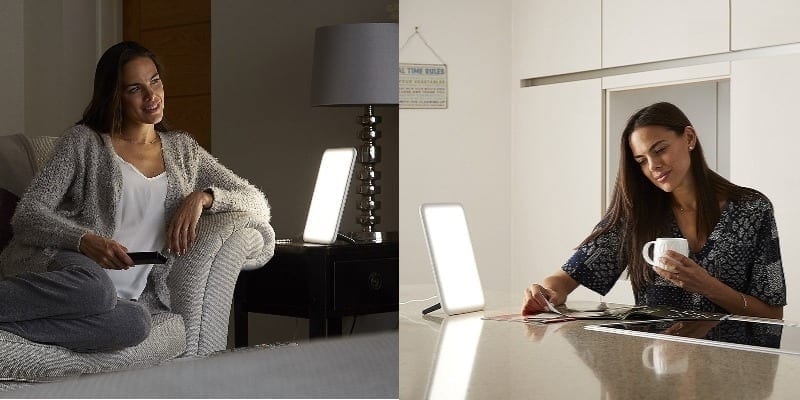
The idea is that you spend up to 30 mins a day in proximity of the light source. It helps ‘top up’ your exposure to light.
I have no idea how to manage this next suggestion: Avoid stress. How? I guess I could plan Christmas in advance – birthdays too. Maybe tone down the birthday parties – no more whole class gatherings! I definitely won’t move home again in December … that really was hard going! Perhaps I need to find some time for myself … treat a friend to a spa day, or just ‘get away’ for a few hours?
Diet is an important one, as always. Try to resist (or at least restrict) the sugary carbs and ‘comfort foods’, while boosting fruit and vegetable consumption.
Vitamin supplement can also be beneficial. Urgent-D, by VEGA Nutritionals, is a high-strength Vitamin D3 chewable tablet. They also sell an EveryDay-D blackcurrant chewable tablet, suitable for adults and children over 4; and Infant-D, hyper-absorbant drops for infants.

NHS guidelines recommend that we all take a Vitamin D supplement during the winter months. It’s very difficult to get the dose required from diet alone.
What am I doing to help myself?
Well, I’m not taking the antidepressants. I’m making an effort to walk the dogs every day (rather than relying on Huw to do it). On bright days, I try to leave the laptop and get outside. I’ve turned to Slimming World to help quell the compulsion for ‘comfort food’. I’ve been taking a single VEGA Urgent-D chewable Vitamin D tablet each day. And while I’m working on my laptop, my Lumie Vitamin L light therapy box is staring brightly at me, just to my left.
It’s too early to tell if my efforts will help reverse my SAD symptoms. However, I cannot deny having more energy since taking the supplement and using the light therapy box.
Of course, I’d rather be in the Maldives … or anywhere bright and warm to be honest (any offers?!) But if supplements and a therapy lamp help me cope and manage the drab, dull winter months, well, that’s very do-able.
I am sure that this post will resonate with a lot of you. Do you feel drained of energy and low in spirit when the weather is cold, dull and miserable? Could you be one of the up-to-20% of the population suffering from mild SAD? Like me?


