Back in the summer we took our children on a totally unique ride – the Southsea (Hampshire) to Ryde (Isle of Wight) Hovercraft. I first experienced hover travel when I was a child, about the age mine are now. Back then, the technology was in its infancy, yet larger vessels were already speeding across the English Channel to France. Nearly 40 years later, the Southsea to Ryde hovercrafts are the last remaining passenger hovercrafts in service. Having lost my mum last year, I felt the need to retrace some old, happy steps …
What is a hovercraft?
A hovercraft is a unique beast! It’s amphibious … it has a skirt of air that skims over both water and land. The hovercraft was created by British inventor Sir Christopher Cockerell about 65 years ago. His craft could land on any beach, therefore doing away with the need for docks and ports. And it was fast – the distance between Southsea and Ryde is 4.4 nautical miles. The conventional ferry takes 45 minutes; a catamaran service takes 20 minutes. The hovercraft whizzes over the Solent in under 10 minutes. It’s fast!

To describe it, you have a passenger cabin not unlike a wide aircraft. Above this cabin is the cockpit.

When ready to depart, the skirt/balloon under the cabin is filled with air drawn in from around the craft from the two huge propellers and fans, lifting the cabin off the ground. Propulsion comes from two engines and steering from rudders towards the rear of the craft.
What happened to passenger hovercraft services?
Passenger services over to France ceased in 2000. They simply couldn’t compete with the alternatives – ferries that could carry many more vehicles per crossing – and of course the Channel Tunnel. Hovercrafts are also extremely noisy – not popular if you lived close to a landing stage. There were other passenger hovercraft services running around the world, but these too have since ceased trading.
Which makes this Southsea to Ryde journey the only commercial hovercraft in the world. And it’s so popular that the company recently replaced their fleet with two brand new hovercrafts to meet the demand.
Our experience
We booked in advance for our crossing, knowing it would be popular. It was actually really stress-free. We parked the car in the huge carpark opposite, checked in, got into line – and waited. Because a crossing only takes 10 minutes, you’re not waiting long. The hovercraft turns up, deflates, the passengers unload … all in under 5 minutes! Before you know it, you’re picking your seat and doing up your seatbelt.
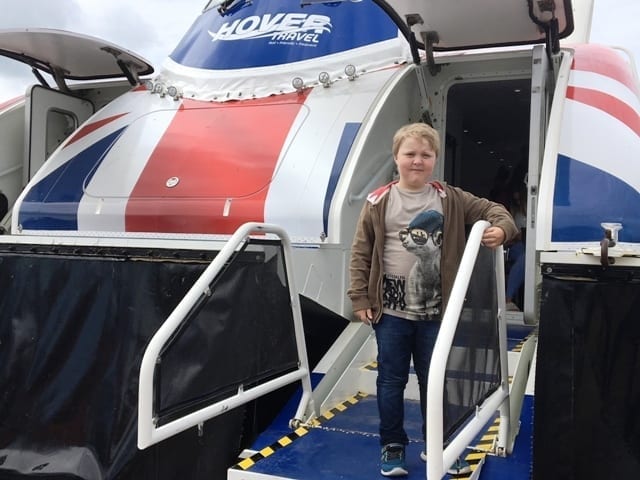
The seats are comfortable – Toby said a LOT more comfortable that the seats in the Etihad A380 that numbed our bottoms during a previous long-haul flight!

There’s a quick safety briefing, the propellers start up (it gets a little noisy) and you lift off the ground. The children found this quite funny. Then we simply turned on the concrete ‘beach’ and whizzed straight towards and onto the water.
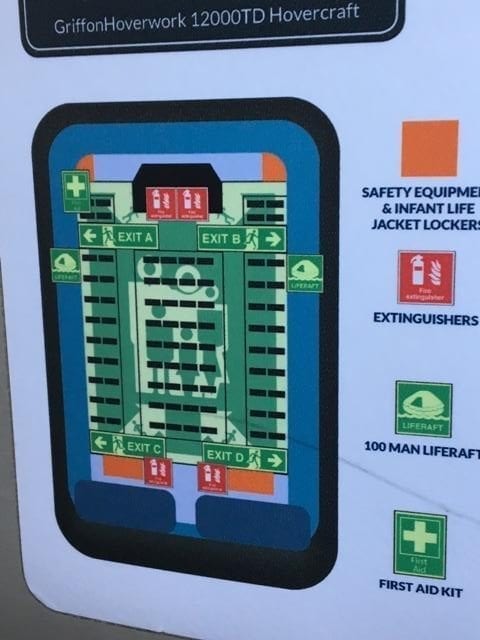
It was impressively smooth! And definitely fast.
The tide was w-a-y out when we arrived in Ryde. A hovercraft is great here – if you arrived by boat you’d have to moor a good quarter of a mile away from the terminal. The hovercraft simply skimmed over the sand.
More information
The terminal in Ryde, Isle of Wight, is next to the bus station. Ryde is lovely in its own right, but from here you can join several open-top bus tours. We took one down to Shanklin, where we had a lovely pub lunch, before heading back for our return hover ride.
It is such a fun day out. It’s a unique way to travel – it’s an experience! I remember, like it was yesterday, my mum and dad taking me and my brothers on one back in the early 1980s. In 2017 I took my two children and I’m sure they’ll never forget it either.
Want to find out more, or book tickets? Here’s Hover Travel’s website. Go on – make some memories x