
While in the Dordogne we wanted to visit a diverse range of attractions. Having visited a castle, walnut orchard, troglodyte village and a fortified manor house, last on the list was a cave. In the Dordogne there are lots of caves, but having picked up lots of leaflets from the tourist office, the one that appealed the most was Les Grottes de Maxange. Why? Simply because you are allowed to take photos (no flash, no videos) … all the others in the Perigord region forbid it. We visited the morning before we had to start our journey back to the UK – and I think we left the best to last.
Location and Accessibility
Les Grottes de Maxange is located in Le Buisson de Cadouin, a relatively short drive from our Eurocamp base in Le Bugue. It’s important to mention that the cave, unsurprisingly, is only dog friendly if you can carry them (they mustn’t be put on the floor while in the cave). Jack and Izzy are not pocket puppies, so we parked in the extremely well-kept carpark of the cave and Huw took the dogs for a walk up in the hills while we ventured under it ?
There are no steps within the cave and the ground was a little bit slippery in places. Good shoes sort this out. There is a slope, mid-tour, but there are hand rails if needed. You cannot take strollers/pushchairs (need to leave them in reception). I don’t know for sure, but if pushchairs are not allowed, I’d assume that wheelchairs are not either. The ground is smooth enough, but the passageways are narrow in places, which is probably the reason.
The cave is open April-November; don’t forget to wear warm clothes!

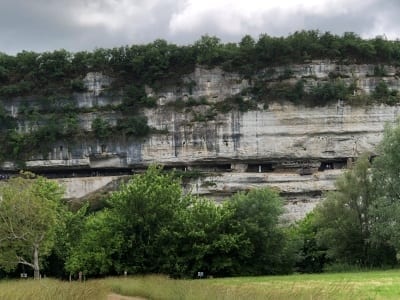
Entrance to the cave
The Grounds of Les Grottes de Maxange
When I mentioned earlier about the well-kept car park, I wasn’t being facetious. The drive up to it, and the surrounding gardens reminded me of a vineyard with its manicured lawns and well-tended gardens. It was very neat.

Grottes de Maxange – Main Building
You enter the main building, which opens into a reception desk, gift store and café open plan areas. There’s also seating outside in the gardens, which includes a children’s play park.
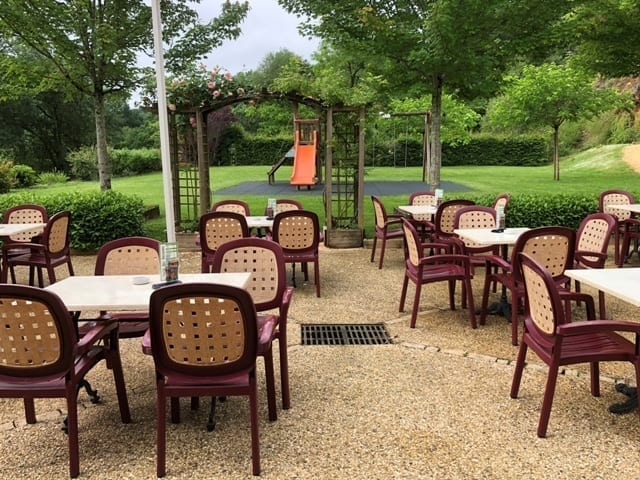
Grottes de Maxange – Outdoor seating and Play Area
There are some lovely mineral- and gem-themed gift items in the shop. We booked in for our tour, and because the weather was so nice, we sat in the gardens watching the birds until we were called.
The Tour
You can only visit Les Grottes de Maxange on a guided tour. The tours are spoken in French; however, you are given a laminated numbered guide before you enter – the guide points out the numbers as you progress through the tour, so you can read a description in your chosen language.

Grottes de Maxange – Tour Information Sheet
Our guide’s English was quite good too – so we could ask questions.
There were approximately 10 people on our tour – a mix of nationalities and ages. In total the tour lasts around 45 minutes. In terms of distance covered, it’s quite a short walk inside the cave – purely because there’s so much to see and appreciate in that short space!

Grottes de Maxange – Toby Reading the Tour Information Sheet
So What’s so Special?
OK, to get a little bit ‘cave techy’ … when water drips from the roof of a cave, it deposits a small amount of calcium carbonate (calcite) that is carried in the water. Over 100s of years this build-up becomes a stalactite. The water dripping to the ground also deposits calcite forming stalagmites. Occasionally they grow and meet in the middle, forming a column. However, in Les Grottes de Maxange something peculiar has happened. It’s difficult to describe, but it’s as if the mineral deposits are defying gravity and growing outwards instead of down or up. Let me show you …

Grottes de Maxange – Eccentric formation
These unusual formations are referred to as ‘eccentric’ – and they are very rare. A combination of the porosity of the limestone and the micro-climate, along with the really slow-moving water, results in capillary action (rather than gravity) dictating where the water goes. This results in the water being drawn sideways and upwards as well as downwards, leaving mineral deposits in the same way as the stalactites and stalagmites. In a cave you expect (hope) to see spikes of stalactites hanging from the ceiling; it’s impossible to imagine what you’ll see on this cave tour until you are actually there. Like these …

Grottes de Maxange – Eccentric formation

Grottes de Maxange – Stalactite, Stalagmite and Eccentric formations
As well as the eccentric formations, you can of course see stalactites and stalagmites, columns, and also aragonite (another form of calcium carbonate).
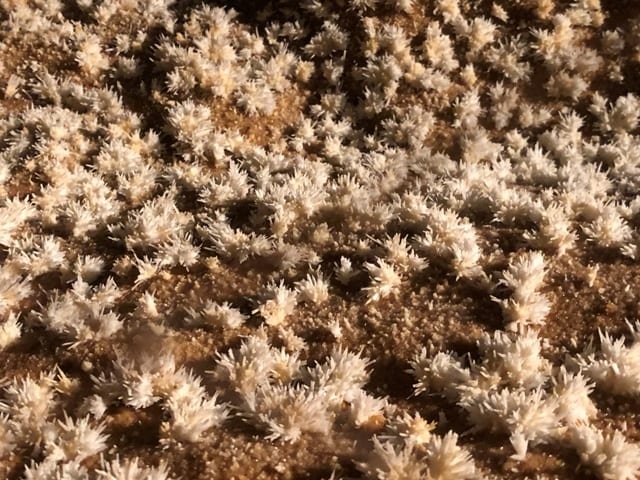
Grottes de Maxange – Aragonite
There is also evidence that the cave bear inhabited here too … here’s some claw marks.

Grottes de Maxange – Cave Bear Claw Marks
History of the Cave
Although the cave was formed 60 million years ago in the Tertiary period, it was only discovered in 2000 during construction work to start a stone quarry. During the exercise a small cavity was exposed and once cleared the formations were uncovered. At this point the plan to open a quarry was suspended.

Grottes de Maxange
The word ‘Maxange’ is a mix of Maximillian (quarry owner) and Angel (the quarryman who discovered the formation). The cave is around 200 metres long; the lower cave is around 70 metres and is where you can see aragonite – the upper cave (130 metres) has impressive numbers of formations.
Visiting
After the tour, the three of us met up with Huw and the dogs back at the car. We had enjoyed the tour so much, we wanted him to take the tour too. Unfortunately, the caves closed for lunch, and we needed to get back to pack as we were heading home. I really feel that Huw ‘missed a gem’ and it would be top of the list of places for him to see if we return to the region. It really is a fascinating cave visit, and if you are in the area you really should book onto a tour.




This looks amazing but I’m not sure my claustrophobia would let me go in!
What a lovely day out. I get claustrophobia, but if I know I can get out I’m ok!
I do love a good tour around places am visiting but caves are not one of them lol. The formation looks great though.
That is my kind of day out, I love exploring caves as I am a bit of a geology geek
I have never explored caves before. I bet it would be fun.
Oh wow this looks amazing! I had some fab holidays in the Dordogne as a child!
Oh wow this looks incredible! We love exploring. The girls would love this
The cave is gorgeous. I would love to take my teens and explore natural wonders just like this!
Oh wow, this is so cool! I have done lots of caving etc but I’ve never been on a tour like this. It looks fascinating.
Wow this looks so interesting! We are planning on travelling the Dordogne when we sell our house so will have to visit
Oh, my word what an amazing looking place! That entrance to the cave is something else!
This looks a lovely day out. How pretty are those formations!
Wow this is so cool! They look so pretty but also very eerie…this is exactly the sort of place we love to explore.
Wow this looks amazing! Really pretty and quirky. They entrance to the cave looks great too. A fun adventure.
This sounds incredible. As a kid we went to France a lot for holidays, often with Eurocamp, and we always visited caves. I find them absolutely fascinating. The history and the beauty of the stalagmites. These caves looks fantastic, thanks so much for sharing. The Dordogne’s is definitely somewhere I would love to take my son.
I love these places. It’a amazing what nature can do.
Home eding the girls means we love doing things that are different and this looks great. I know my girls would love it too!
Ooh I love days out like this! What a great place to visit and explore!
I don’t know why but whenever I think of France the idea of caves even existing there never crossed my mind. Which is silly because there are caves everywhere if you really look. Now I will think of these caves whenever the topic of France comes up 🙂
This sounds like a really interesting tour. I remember visiting a cave years ago with stalactites and stalagmites and it was amazing to see!
Oh wow this is definitely up my street. I love caves and exploring
I love visiting caves, I find them so fascinating. This looks like a brilliant day out
This looks like an amazing place to visit. I love caves and all things outdoors so to speak xx
Oh wow, what an amazing place to explore. I didn’t know they could grow sideways too.