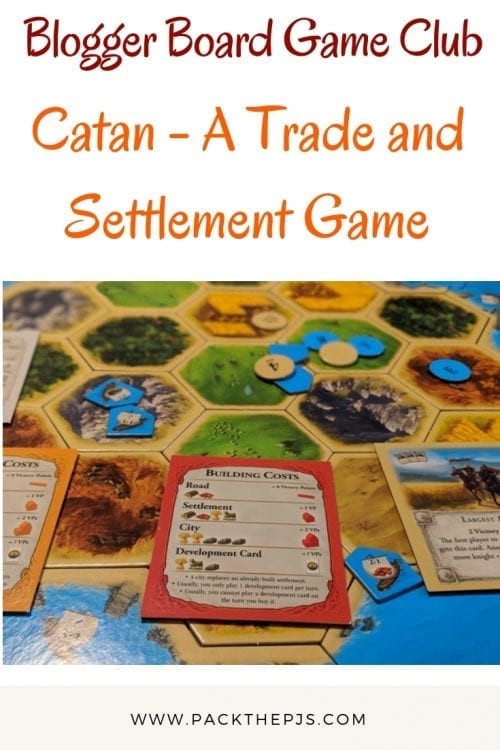
Catan is a German-style board game for 4-6 players designed by Klaus Teuber and published in Germany in 1995. The game has won a great number of awards, including GamesCon Vegas Game of the Century. There are also multiple expansion packs that include spin offs such as Star Trek and Game of Thrones, as well as knights, pirates and seafarers. There are also historical scenarios such as the Pyramids of Egypt, Alexander the Great’s Empire, Great Wall of China and the Trojan War. Catan involves a large amount of strategy, while still being fairly simple to learn. This means the game has a huge following and can be played both as a hardcore boardgame or on a more casual level among friends.

As you get better at the game, expansion packs can be purchased. These can only be used with the core game and add new parameters to the game while also allowing more players to be involved. Catan and its many expansions are published by Mayfair Games. More than 22 million copies in 30 languages have now been sold. Such is the game’s popularity, there are now electronic versions, dice and trading card versions.
Setting up
Catan represents an island discovered by settlers and traders, which is developed during the game. Players act as the settlers and each player attempts to build and develop their cities, roads and holdings while trading and acquiring resources. Each player gains points as their own settlements grow, and the first to reach 10 victory points wins the game.

At the start the hex game board must be constructed to represent the different environments on the island. Then each player places two small houses on spaces where three terrain hexes meet. These are the starting settlements. Each hex is marked with a dice roll number. The dice are rolled in turn. Each player who owns a settlement adjacent to a terrain hex marked with the number rolled receives a resource produced by this hex. Hills produce brick, forests produce timber, mountains produce ore, fields produce grain, and pastures produce wool. The resources are used to expand across Catan. This is achieved by building roads and new settlements, or upgrading existing settlements to cities. As an example, a road costs 1 brick and 1 timber. If players do not have the necessary resources, they can acquire them by trading with opponents.
The game play
Each settlement is worth 1 victory point and each city is worth 2 victory points. If you expand cleverly, you may be the first player to reach 10 victory points and win the game! The robber token can be a game changer. This is initially placed on the desert; if any player rolls 7, the robber must be moved to another hex, which will no longer produce resources until the robber is moved again. That player may also steal a resource card from another player. In addition, when a 7 is rolled, all players with 8 or more resource cards must discard half of their cards. Catan has a huge amount of depth and quirks, sometimes it is more like Chess than a board game!

How we faired
The kids, who are quite good at board games, loved it. I believe it takes a little time to get used to any game and to work out the strategy. Catan is quite simple to learn but you have to build experience to become good at it. Millie and Toby enjoyed the game play and quickly became quite competent players. I was not very good but eventually became adept at the strategy.
It is a very good game and I can recommend it. This is definitely one to add to the very small list of mega games such as Monopoly, Scrabble and Risk.
Disclosure
We received this game to play as we’re members of the Blogger Board Game Club. The game description and our thoughts about the game are our own and haven’t been influenced in any way.