Burgh Castle (NR31 9QF) is one of the best-preserved Roman military ruins you will find. Situated near the village of Burgh Castle in Norfolk, the fort can be found on the east bank of the River Waveney. This is within the Broads National Park, and some 6 km west of Great Yarmouth. The fort was a huge structure for its time – it still is, considering it was abandoned in 5AD. Strategic positioning was key in Roman times and the fort was built on high ground overlooking a large, but now vanished, estuary that gave access to the interior of East Anglia, particularly the Roman settlement at Caister-by-Norwich (Venta Icenorum). Although it had no connection to the Roman road network this was a very important fort.
Visiting Burgh Castle
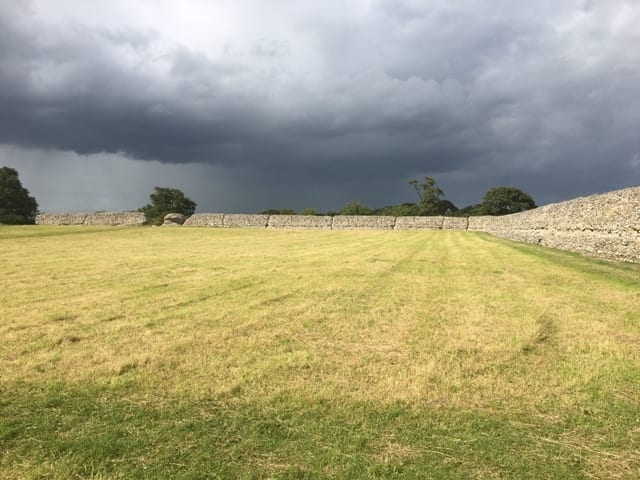
The fort has its own car park which is found off Butt Lane. It is reasonably well sign-posted (although be careful not to turn into the caravan park, like we did!) The castle walls are a short walk from the car park, just past the church. Given that the walls were built so long ago they are an impressive 3 metres high. Some parts have ramparts that can be walked along allowing visitors to admire the view. Climbing on the walls themselves though is not allowed.
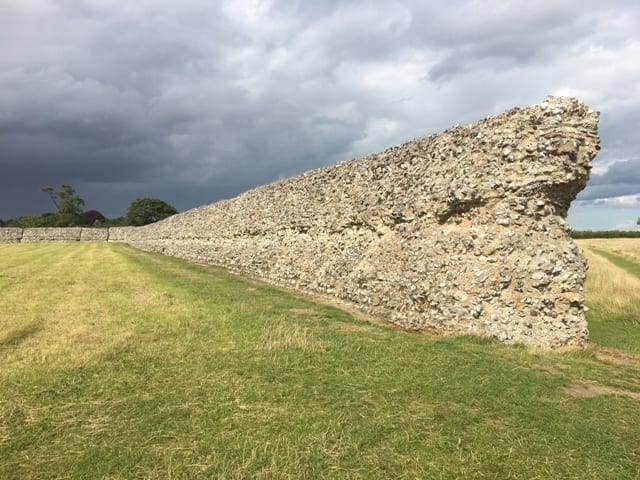
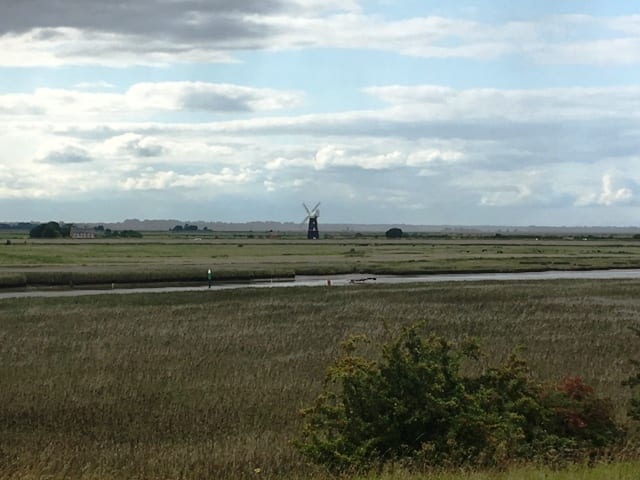
On the day we visited Burgh fort the scenery over the estuary was dramatic with the heavy clouds of a thunder storm rolling in towards us. It was easy to see why this site was chosen because of its commanding position, even over the modern estuary.
Walking around the fort there are information plaques which give a very good narrative of its history and allow one to build a picture of how it must have been.
Background History
Burgh Roman Fort was actually one of a pair guarding the trading wharfs against sea-borne raids. It is one of nine Roman forts in east/south England, known collectively as the Forts of the Saxon Shore. With 3.5-metre-thick walls and projecting turrets it differed greatly from earlier Roman fortifications in allowing ballista’s to be specially mounted to defend the structure. The fort was garrisoned, at least for a while, by a 500-man strong cavalry unit and it may also have acted as a base for the Classis Britannica, the British arm of the Roman Navy.

Burgh fort is free to visit. It is very educational and a definite respite from the busy, loud attractions such a short distance away. It is a lovely nature walk too.
The fort is managed by English Heritage. The entire site, totalling 90 acres, was bought by the Norfolk Archaeological Trust in 1995.
We visited Burgh Castle while staying at the Long Beach Camping and Touring site, a few miles away in Hemsby. For more information, please visit Burgh Castle’s listing on the Norfolk Archaeological Trust’s website.