The Romans were quite active in the areas around Great Yarmouth in Norfolk. There is the fort at Burgh Castle, which we visited last year, and also the Roman fort at Caister-on-Sea. The fort is located on the western edge of the town.

Built in 200AD, Caister-on-Sea fort was occupied by the Roman army and navy until around 370-390 AD. It was garrisoned by between 500 and 1,000 soldiers and seamen. It was strategically important right up until the end of the 4th Century, when the Romans left Britain for good. Archaeologists have actually discovered around seven separate coin hoards in these ruins.
Strategic Importance
The fort was built on an island on the north side of an estuary, which was the confluence of four major rivers (Ant, Bure, Yare, and Waveney). The fort controlled a wide area. The Roman Shore Fort site of Burgh Castle, which lies a few miles to the southwest was on the other side of the estuary (constructed in 260 AD). Together these two great forts protected Roman shipping and merchants and the estuary/trading ports. The Caister-on-Sea fort was in fact part of a chain of coastal forts along the ‘Saxon Shore’, from the Wash around the east and down to the south coast of England. They acted as a defensive line against seaborne Saxon raiders.

Current Day
Today, the northward extension of the Yarmouth sandbank has meant that the shore fort at Caister-on-Sea now lies some distance inland. The town of Great Yarmouth occupies the majority of where the estuary would have been in Roman times.
Archaeologists have found a range of items at the fort that provide a good picture of life there in Roman times. Personal items such as brooches, beads, bracelets, necklaces, rings and hairpins indicate that women and children lived in the fort. It is possible the soldiers were allowed to bring their families. There are also finds of old and broken equipment including spearheads, arrowheads and belt buckles to show the military side. The domestic arrangements of the people who occupied the fort is shown by charred grain, fish bones, over 10,000 oyster shells, and the bones of cows, hares, foxes, badgers and ducks that have been found.


The Building
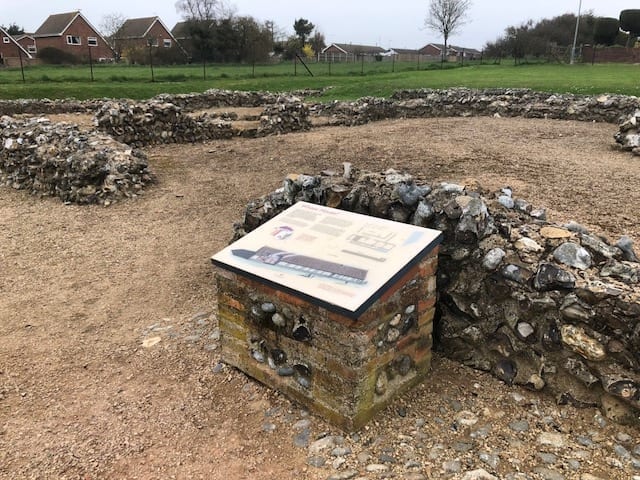
The fort was originally around 8.6 acres in size with a square shape. There were large stone perimeter walls 4 to 5 m (13 to 16 ft) high, earth ramparts and ditches of 175 m (574 ft) in length on each of the four sides. In addition, there were defensive towers at the corners and fortified gate houses in the middle of each side. There would have been a pebbled street from the fort’s south gate leading down to the beach/harbour where goods were landed.
The complex would have included headquarters, barracks, granaries, workshops, stores and stables. There were also some larger houses for officers and Roman VIPs. One building provides a good example of a hypocaust (Roman underfloor heating).
Visiting
You cannot miss the fort. It is on the right-hand side of the road as you head from Caister-on-Sea towards Great Yarmouth. It is free to visit and there’s a substantial off-road lay-by to park in. We stumbled across it while exploring the area around our campsite in nearby Hemsby.

For more information, please visit the English Heritage webpage here.