Towards the end of the school summer holiday, while staying in our caravan in Caister, I took the children on a visit to the three main museums in Great Yarmouth, Norfolk. The most notable museums that describe the history of the town are the Time and Tide Museum, the Elizabethan House and the Tolhouse Gaol. All of them can be visited in a day with only a short walk between them.
The best place to park is the Kings Street carpark. This is fairly central for all three museums and there are plenty of places close by to get lunch. An added bonus, the steam drifter Lydia Eva is moored across the road from the Elizabethan House. This can be visited for free. During our visit, the Time and Tide museum also had a very good Titanic exhibition. This taught us things we didn’t know. The staff at all the museums were very knowledgeable and helpful. They gave a lot of background on the history of the town.
The Time and Tide Museum
The Time and Tide museum is by far the biggest of the museums and is a real celebration of the history of Great Yarmouth. Because of herring fishing, GY used to be the fifth richest town in the UK. The museum is based inside a three floored re-purposed herring curing factory. This industry is showcased throughout with a lingering but not unpleasant trace odour of smoked fish in some areas. The children were very interested as the social history was laid out in a ‘Horrible Histories’ type format. I think sometimes this is the best way for them to learn!
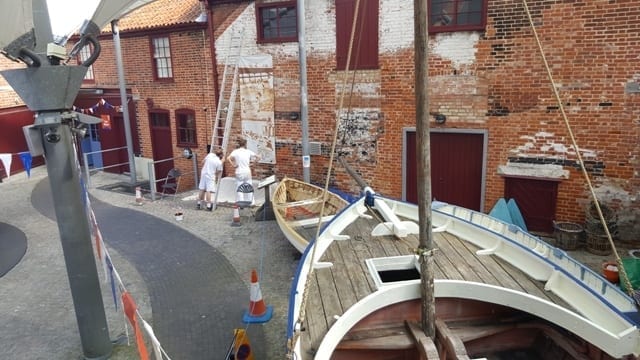
The museum is set up as a tour and you can take a headset commentary to bring it to life. The first section showed how old Yarmouth was set up in very narrow streets called ‘Rows’, which were numbered. This was done to make the town easier to defend. Marauders would move through these streets and their narrowness allowed one man to defend each one.

The ‘Rows’ were mostly destroyed during two nights of intensive German bombing in 1941. As Yarmouth was close to the continent and on the mouth of the river Yare it suffered a great deal from German bombing during both World Wars. Great Yarmouth was an important UK deep water port. In fact, the first two people to die in an air raid in the UK was in 1915 from a Zeppelin airship attack in Great Yarmouth.
Great Yarmouth and the Dutch
The museum also highlighted the town’s relationship with its nearest European neighbour – Holland. The Dutch held an annual herring fair in the town (the Dutch Fair). They settled here in great numbers and also shared their fish preserving secrets with the fishermen of Gt Yarmouth. The Dutch have fished and lived in the town since the 1490s. To this day the town has a relationship with the Dutch city of Scheveningen.
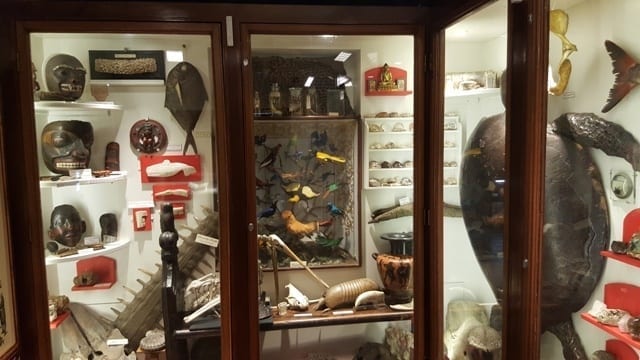
The Time and Tide Museum must be experienced; it is well worth a visit. One highlight is the museum ‘Boulteranium’. This is a curiosity booth museum with strange objects from all over the world such as giant fish, turtles, shrunken heads, masks and strange animals. It was set up as a cabinet of curiosities by Daniel Boulter, a local businessman, in 1778 in the marketplace of Great Yarmouth.
The fishing industry declined and its only legacy today is the huge number of fish and chip shops throughout the town. Once upon a time boxes of Great Yarmouth herring, kippers and bloaters were sent all over the world and for the town ‘Herring was King’. But those days are long gone. However, the museum lives on and brings to life this important part of the social history of Great Yarmouth.
The Tolhouse Gaol
One of the smaller museums is the Tolhouse Gaol (built in 1261 in Middlegate Street). This is one of the UK’s oldest gaols, which dates back to the 12th Century. It was used to incarcerate thieves, smugglers, witches, pirates and murderers during its life-time.
The top floor was a court room and there are stairs built from the lower holding cells that come up to where the ‘dock’ used to be. There is again a free audio guide to listen to the gaoler and his prisoners describing their experiences.

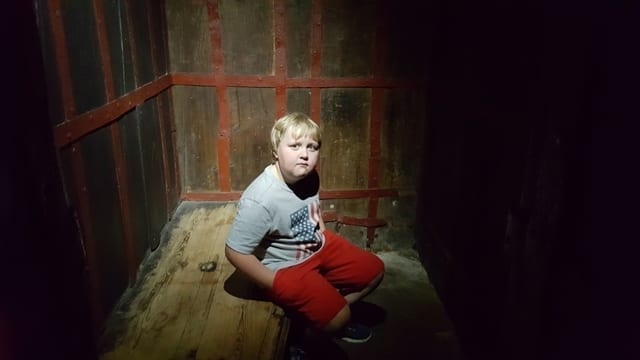
There are a load of old weapons and jailer’s irons on display as well as some Horrible Histories-type stories to read, and some death masks of executed murders. The cells are brilliant and are just as they would have been used. There is something spooky about the cells and a bit of a depressing atmosphere. I suppose this is to be expected with all the human suffering that would have been experienced there.
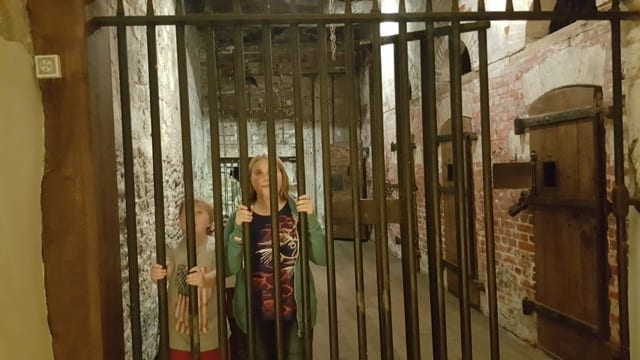
The kids loved sitting in the cells and rattling the iron bars.
The Elizabethan House
This Elizabethan House is an old merchant’s home on the quayside in Great Yarmouth. It dates back to 1596 when it was built by Benjamin Cowper. It was bequeathed to the National Trust in 1949. The house is famous for a number of things. It has connections with Oliver Cromwell, who visited his friend John Carter (a prominent local merchant who acquired the house from Benjamin Cowper) in 1635. The house was also a regular meeting place for Cromwell supporters/Parliamentarians during the Civil War and it is here, apparently, in November 1648 that the fate of Charles I was decided.
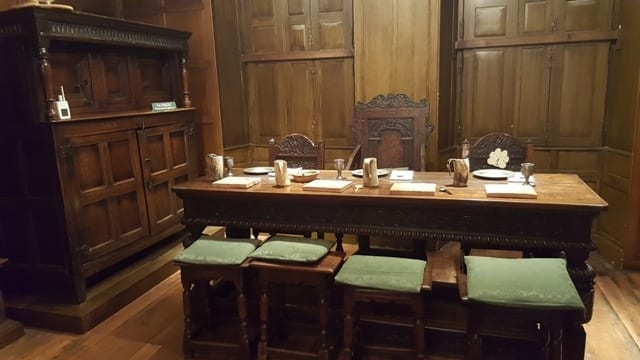
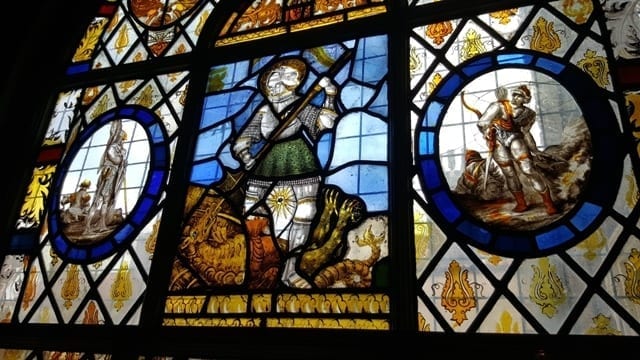
Anyway, many of the people who signed the King’s death warrant were there on that occasion. On 16th December 1654 Oliver Cromwell was proclaimed in the Market Place of Great Yarmouth Protector of the Commonwealth of the United Kingdom and he stayed in the house that night. The house is full of exhibits in the different rooms with original panelling, excellent stain glass windows, herb garden, scullery, buttery and the upper rooms with an audio exhibit purporting to describe who the parliamentarians plotted the execution of Charles 1st.
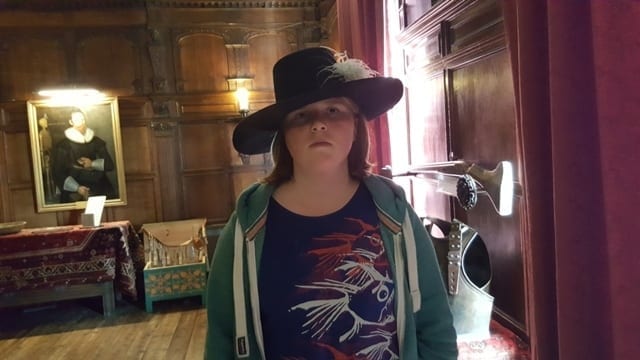
There are also lots of costumes and armour that the children can try on with Round head helmets, Royalist hats, breastplates, gauntlets and a whole lot more.
This is an excellent interactive museum and can take hours to explore properly, and it is well worth it. There is also a lot of local artwork, which is worthy of seeing.
Summary
To learn about the history of Great Yarmouth these three museums are huge educational for children and adults. I thoroughly enjoyed the day we spent ‘museuming’, as did the children. However, there were some complaints from them about sore feet, but the burger and fries afterwards more than made up for it!