
This is usually a post that Huw would write. But I must confess it’s my own fascination that resulted in Millie-Mae accompanying me on a countryside drive last night, chasing an airship. Seriously! Specifically, Hybrid Air’s immense new Airlander 10 airship, which lives in the famous Cardington Sheds about 12 miles away from where I live (and grew up).

Over the last 40(cough)-something years, I’ve witnessed the sheds deteriorate to the point of becoming dangerous, to finding a new-found purpose and vibrancy. I’m no aviation expert (nor novice really), but I’ve always been fond of the Cardington Sheds, because of their history.
Cardington Sheds: A bit of history
There are two sheds in Cardington, a small village about 5 miles south of Bedford. They are huge and dominate the landscape. Shed 1 was built in 1916 (during World War I) by the Shorts Brothers Engineering Company specifically in which to build an airship to challenge the German Zeppelins. 4,000 tonnes of steel was needed to build the shed, which is 812 feet long, 180 feet wide and 157 feet tall (internal dimensions). Each door weighs 470 tonnes. This huge building would house two airships that could match the size of the largest Zeppelins.
The R31 was the first airship to come out of Shed 1. However, this occurred within a week of Armistice Day in November 1918. The post-War depression resulted in the airship station being closed in 1921. This was after the construction of the R38 airship, and scrapping of the R37.
In 1924 it reopened, and the following year Shed 2 was assembled alongside Shed 1, having previously been located in Norfolk. The focus now was on airships for civil transportation and included the construction of the R101.
R101 Airship
The R101, completed in 1929, was the world’s largest aircraft in its day. It was 731 feet long and of a hydrogen-filled rigid design. To give you an idea of scale, the R101 had passenger accommodation spanning two decks to accommodate 50 passenger cabins (for 1, 2 or 4 people). There was also a 60-seater dining room, two promenade decks, and a large 5,500 square feet lounge. Amazingly, there was also an asbestos-lined smoking room for 24 passengers.
On 5 October 1930, while carrying 54 passengers, it crashed over France. All but six passengers were killed, including many senior personnel and designers from Cardington’s Royal Airship Works. The crash brought Britain’s involvement in airships to an end. The R100, a predecessor to the R101 was dismantled inside Shed 2. The Airship Station was then reduced to a small team of maintenance staff.
World War II
With the threat of World War II becoming more real, by the end of the 1930s the Cardington Airship Station was back up and running. This time it made kite (barrage) balloons. In 1936 it became known as Royal Airforce Station Cardington. Cardington produced up to 26 kite balloons each week and trained some 10,000 operators with a further 12,000 drivers.
After WWII the Sheds again fell silent. The RAF sold the site in 1999.
Modern Day: The Sheds now
Over the last few years it has been ‘all change’ for the Sheds, and for Shortstown village. Major redevelopment and new housing (called New Cardington) is still under construction, bringing new families to the immediate area. The original, impressive, listed Administration Building (the Shorts Building – built originally to be an airship passenger hotel) has been rejuvenated with public meeting spaces, upper-floor apartments and children’s centre.
Shed 2 has an interesting ‘new life’. Cardington Studios is now a film location! It’s a huge studio space that Warner Bros used for films including Batman Begins, Fred Claus, The Dark Knight, Inception, The Dark Knight Rises, and Pan. Add to this list Star Wars Rogue One and Fantastic Beasts and Where to Find Them and you’ll appreciate Shed 2 is part of some major cinematography these days! The immense building has also been a useful space for bands to rehearse for tours. Not least Take That, who rehearsed their Circus tour there in 2009 (with noise complaints from neighbours!)
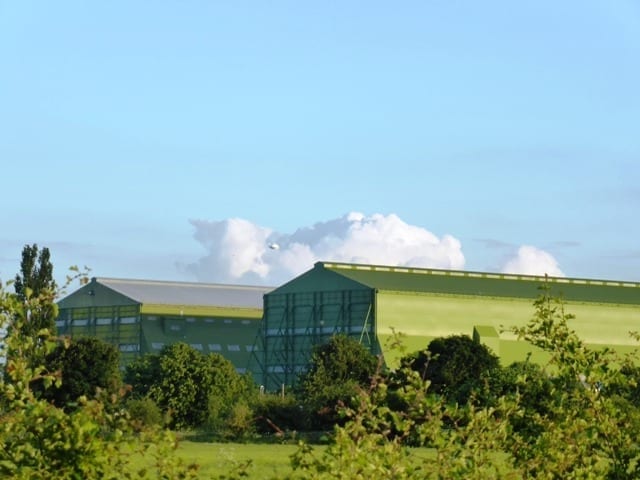
Cardington Sheds, Bedfordshire
Shed 1, for a few years now, has been home to Hybrid Air Vehicles, a company who has brought airships back to Cardington. And this long introduction now leads on to our ‘chasing an airship’ drive last night!
Airlander 10 (named Martha Gwyn)
Originally designed for the US Army, when the airship project was cancelled it was bought by Hybrid Air Vehicles, packed up and brought to Cardington. It is huge. Let’s talk size …
Airlander 10 is 92 metres long, 26 metres tall, with a wingspan of 43.5 metres. This makes it the largest aircraft currently flying.
It is powered by four diesel engines, has a cruising speed of 92 mph and can stay airborne (manned) for 5 days or 10 days (unmanned).
It’s totally different to the early airships – you cannot compare them. It has a funny shape – technically it’s elliptical, but we tend to affectionately refer to her as being the ‘big bum’. Buoyancy is provided by helium, which is lighter than air and non-flammable.
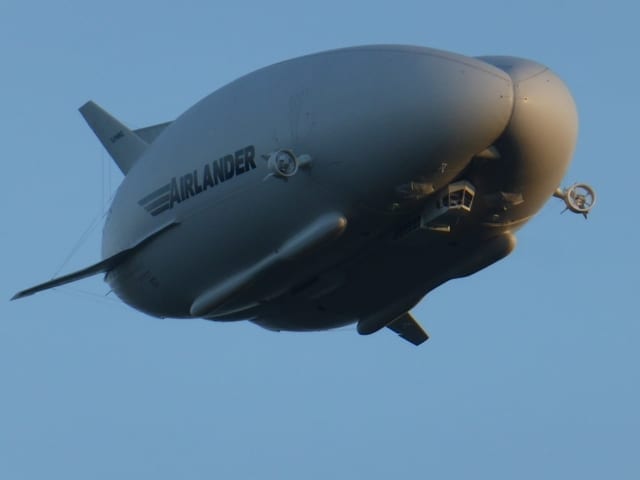
Airlander 10 has pneumatic skids underneath. This enables her to land and take off from all kinds of terrain, including water. On the ground, the Airlander 10 weighs approx. 1 tonne.
Airlander 10 in the skies
Airlander 10 first flew in August 2016 (I missed it). In the same month, at the end of its second test flight, it made a hard landing that damaged the cockpit. This resulted in it going back into Shed 1 for repairs and a design modification. It flew on test flight 3 a couple of weeks ago (I missed that too!), and then test flight 4 took place yesterday. No way was I going to miss it!
Follow that airship!
At just gone 6pm I saw an announcement on Facebook that Airlander 10 was up in the skies on a test flight. I tried to track its path using FlightRadar24, but the route was bouncing around too much to be reliable. So instead I drove up to collect Millie-Mae from her karate class with the announcement that ‘we’re going to find an airship’! Armed with cameras (phones and the real ones) we set off … within 2 minutes we could see Airlander over a village in the direction we were heading. So we took chase – all the way to Cardington.
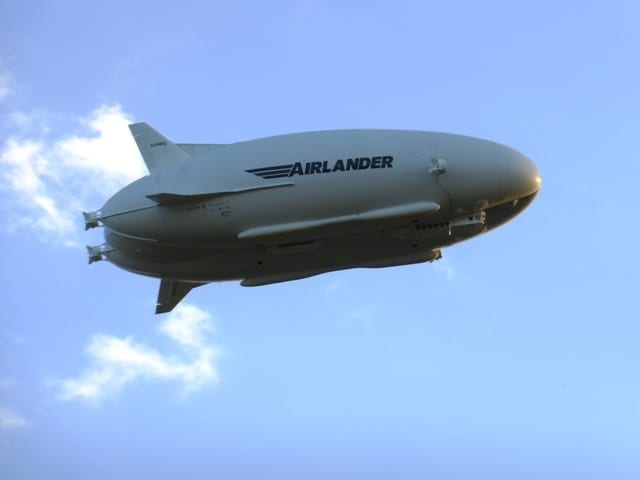
Unsurprisingly we weren’t the only ‘airship spotters’ out last night and there was nowhere to park. But I’d already thought about this. We instead drove to the bottom of the new building development, New Cardington, and parked up. Airlander 10 was circling the Sheds, so we got some good photos 🙂
As a treat (and because she hadn’t eaten since lunch) we headed across the way to get a bag of chips. Rather that eat them at a building site I drove to the village of Cardington and around the back of the Sheds … again to be met by LOADS of spotters! We finally found a layby to a farmer’s field and we stopped for a few moments. Guess what … Airlander 10 looked to turn and head straight for us.

Talk about luck – we couldn’t have asked for a better view 🙂 So we took some more (better) photos and headed home, feeling smug.
What will Airlander 10 be used for?
The answer to this question is vague – because there are so many potential applications for Airlander 10. It can carry up to 30,000 lbs of cargo. Because it is quiet it would be good for aerial surveillance. It can assist with disaster relief operations. It could provide luxury passenger services (sky cruising). If Amazon realise their dream of having warehouses in the sky, well, I guess Airlander could be it! Remember the only thing that determines the size of an airship is the size of the building you build it in! Super Sheds could become reality. Once Martha Gwyn completes her test flights and graduates, the world is her oyster!
All I know is that we want to see her, and more airships like her, flying over our rooftops in the years to come 🙂


