
During our motorhome tour of Scotland, we literally stumbled across Culloden while driving from the Black Isle towards the Cairngorms.
The battlefield of Culloden Moor is the site of one of the greatest tragedies in Scottish History. It occurred on 16 April 1746 and was the last pitched battle on British soil. Culloden is the site where over 2,000 brave Clansmen lost their lives and their last chance to restore the Scottish crown. The National Trust of Scotland now looks after Culloden Moor and has a remit to return it to the state it was in during the battle.
The battlefield is near Inverness and is well worth a visit. Toby and I did the tour as we are both into military history. We found it is an advantage to be a National Trust member as you can park for free and the visit is cheaper.
Visitor Centre

The Visitors Centre, which opened in December 2007, is a low-rise sweeping structure designed to house artefacts and displays as well as being able to act as a viewing platform across the moor.

The full tour is really worth taking before you head outside. The centre sets the scene and you get the full history of the Jacobites from the start of the rebellion and their early successes, right through to Culloden and finally the departure of Bonnie Prince Charlie from Scotland.
Displays
There were many displays of weapons (mortars, cannon, swords and muskets) and infographics about the times these people lived in.


The Jacobites (Episcopalians or Catholics) did not have the full support of Scotland. In certain places, such as Glasgow, they were given short shrift. Many people in Glasgow, a largely Presbyterian area, were initially against the Jacobites. They had no desire to see the Catholic Stuarts restored.
In the centre is an interactive theatre. I went in alone and was suddenly surrounded by the atmosphere of the battle with images of fighting. It was very emotional, especially seeing the grief on the wives/camp followers faces. I must admit seeing this on a screen and knowing the final outcome could almost make you breakdown in tears. There were many personal stories, social history surrounding the times and accounts of the skirmishes leading up to Culloden. There were tales of military incompetence and indecision and of worn out men with no food and no shoes on their feet who were marched from one end of the country to the other.

The Battlefield
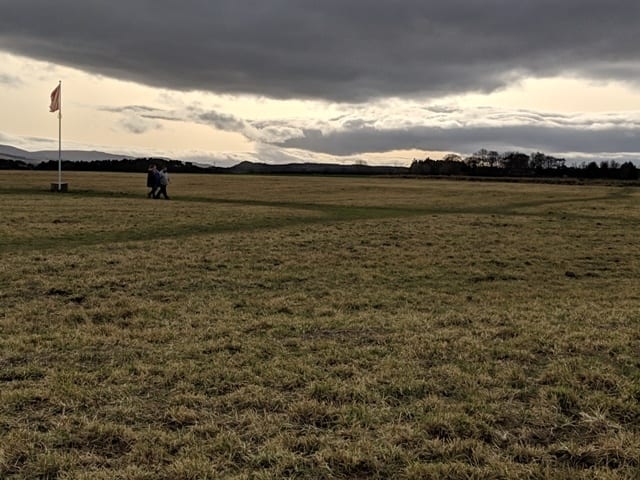
You can traverse the whole battlefield and see where the English and Scottish positions were situated. Toby and I walked from the English positions right across to the Scottish positions. We saw many memorial stones for fallen clansmen and chiefs.

With the overcast but slightly sunny weather there was an atmosphere of sadness and loss. The battlefield is well marked and you can understand the naivety of the Scottish attack and feel the inevitability and have sympathy. The Scots believed in a full-blooded charge and close hand-to-hand combat that was what they lived for. But the English troops were veterans and not easily scared off. They stood and faced the Scots and with disciplined musketry and a close bayonet drill were able to negate the Scottish close combat.
Many Scots lost their lives that day. A charge across an open field into hostile musket fire and then a slim chance at close quarters combat left thousands of dead. The English losses were in the hundreds but the Scots lost around 2,000 men. The Jacobites were finished. There was money from France but there was no one willing or able to fight for Bonnie Prince Charlie’s cause.
The Tour
If you can get on an organised tour so much the better. But if you’d prefer a self-guided walk around, the centre will provide you with a map to point out the important landmarks. These include the 20 feet (6.1 m) tall memorial cairn, erected by Duncan Forbes in 1881:


The English stone marking where the English dead are buried:

The field hospital, Leannach Cottage:

And the many, many markers for the clans and their chieftains.

Go and see the battlefield, visualise the event that happened here, and you will understand the true meaning of war.




What a fascinating piece of history and just look at those weapons! It really makes you appreciate how far we have come
What a great trip to take children on, I love anything that incorporates a little history so they can learn something along the way!
This sounds like a very emotive day out.
I love National trust and all they do to show us how life was and to preserve history forever x
I feel I ought to know more about Culloden. At school Scottish history was forgotten.
Sounds like a guided tour would be so interesting. Looks like quite a different day out
I’ve heard of The Battle Of Culloden but know very little about it – thanks for helping me learn some more history! It looks a great place to visit, too.
Wow, what a great place to visit. Full of rich history and absolutely fascinating. It would be interesting for all ages.
what a view! I will defi itely look something more abt this place and try to visit, looks so interesting
I am loving the displays. What an amazing place!
I’d love to visit here. I’m a bit of a history geek so love anything like this x
Culloden Visitor Centre is great, and an important part of our history. Once of my former interns works there and I’ve been to visit.
Culloden Visitor Centre is great, and an important part of history. Once of my former interns works there and I’ve been to visit.
This looks like such a great place to visit, my kids would love it.
Looks really interesting. We drove our camper around Scotland in April and loved it. We’re definitely going back again so may have to include a trip here
What a fascinating place to visit, looks like you all had a great time
Oh wow what a fasinating visitors centre and place to learn about the history and culture first hand
Laura x