Holidaying overseas with our dogs has become second nature to us – and to them. Not just with Izzy and Jack, but two generations of pet dogs before them have joined us on our adventures. It can be a little daunting at first, but it doesn’t need to be. So I’ve put together this little guide, which I hope will help if you are considering hitting the continent with Rover this summer.
First, can I point out that all of our overseas experiences are for European road trips. Our dogs have never travelled by air, nor by cruise liner (this is an option as Cunard’s Queen Mary II has 24 kennels on board!) So the following information is solely based on Channel crossings and road trips.
Pet Passport
To take your pet out of the UK (and bring them back again without quarantine) you will need a UK Pet Passport. The process of sorting a passport has got easier over the years, but I’m still astounded by the lack of knowledge some UK vets have shown us: Had we not challenged some comments/actions we’d have been stranded in Calais over Christmas twice. The most important thing to mention about the Pet Passport is that if it is filled in wrong, you WILL NOT get back into the UK, however much you argue or beg the officials in Calais. So it’s important to understand what you need to do, both here and while overseas.
A UK Pet Passport costs around £70-100 from start to finish. All of our dogs’ annual vaccinations are recorded in their passports, along with a photo of them and emergency contact details – in much the same way as our own passports work.
When starting a UK Pet Passport the first rabies vaccination is valid for 12 months. Before the 12 months is up a booster will need to be given by your vet. This booster will then last 3 years, but if you miss any of the renewal dates, you’ll have to start all over again so beware.
What to do while abroad
For their passport, your pet (over 12 weeks old) will need a microchip and they’ll need to have a vaccination against rabies. You can travel BACK to the UK 21 days AFTER the vaccination is given. While away on your holiday you will need to arrange to visit a vet as they will need to worm your pet and stamp/sign your passport. You cannot do this yourself. The important rule here is that this appointment needs to be arranged no sooner than 24 hours before you cross back to the UK, and no later than 120 hours.
We always aim to see the vet 2 days before we are due to cross back as this tends to fit between the minimum and maximum times. The overseas vet MUST fill in the correct part of the passport (for worming) and they need to clearly date and time the box and use their long surgery name/address stamp to complete the entry. Finally they need to sign through the surgery stamp. So long as they do this, and you are booked to travel back at least 24 hours later, but no longer than 5 days after the appointment – you’ll be fine 🙂
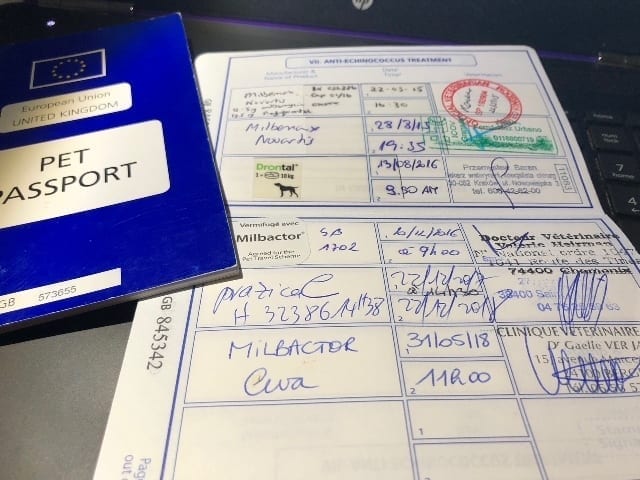
However …
Coming through Eurotunnel, often late at night, we nearly always witness people presenting with Passports not filled in correctly. It is quite a simple process, but you MUST follow the above rules – else you get to spend at least 24 hours in Calais.

Breakfast in Madrid, Spain
What we love about travelling overseas with Izzy and Jack
- We don’t like leaving them behind. When travelling long-haul, or anywhere on a plane or cruise ship, we accept the dogs need to go to a dogsitter or kennels. But if the overseas destination is driveable, they’ll almost always come with us.
- Taking them on holiday with us means we save money on kennels or dogsitter fees.
- Our dogs love travelling, so they don’t have to be stressed being apart from us.

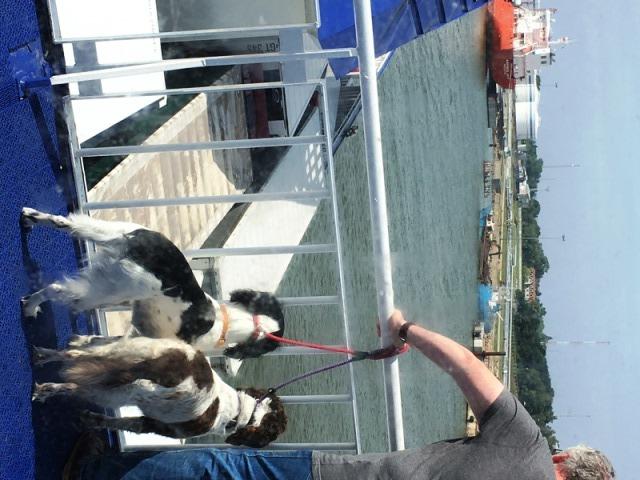
Ferry from Kiel, Germany to Klaipeda, Lithuania
Limitations when you take your dogs on holiday
- You won’t be able to visit a lot of the main attractions. However we have got around this by booking local dogsitters for a day so we can whizz around a city.
- There can be hidden accommodation costs. On a recent overseas trip to the French Alps we booked a dog-friendly studio apartment on Booking.com – we travelled on a budget so chose the cheapest accommodation available that met our needs. It came with the advice that ‘there might be additional fees for dogs’. You really need to watch this! We had to negotiate it down, but they wanted to double the overall rental rate (making them not that cheap at all, and there were other options we could have picked that were better but who didn’t charge for pets). Accept that properties will require an extra cleaning charge, but be aware that some places try their luck, often not telling you until it is too late to cancel free of charge.
- Vets in Europe often charge what they think they can get away with! I know, they do the same here in the UK, but it pays to shop around. Work out where you’ll be 2-4 days away from Calais returning home, then google and email any vets you can find in that area. We once got the Passports stamped in Gdansk, Poland – total cost €10 (3 years ago). Last Christmas, in the French Alps, we were charged €90 in total. This is for a 2-3 minute consultation. But it has to be done – so I repeat, shop around.

Izzy patrolling our villa in southern Spain
Tips for long distance overseas road trips
Our dogs have travelled, by road, all the way to Latvia (twice), France (many times) and southern Spain. It is important that they travel in comfort and safety. Izzy and Jack travel in a crate secure in the boot of our MPV car. The dogs have space to sit and stand, and to lie together without being on top of each other. Inside the crate is a comfortable bed, like those made by Scruffs for travel. We stop every 2 hours – for our benefit as much as the dogs. At every stop the dogs get out the car, and are given the chance to ‘use the facilities’. They are always offered water and a biscuit or two before we get going again. Carry lots of fresh water – keep it cool if possible.
Remember to keep checking that they are not getting warm/hot, especially if heading south towards the Med. If the sun is beating in the windows, blacken them out. Open your windows or turn down the air conditioning if it starts to feel warm. If you are uncomfortable they will be too, so never forget that they are in the car with you.
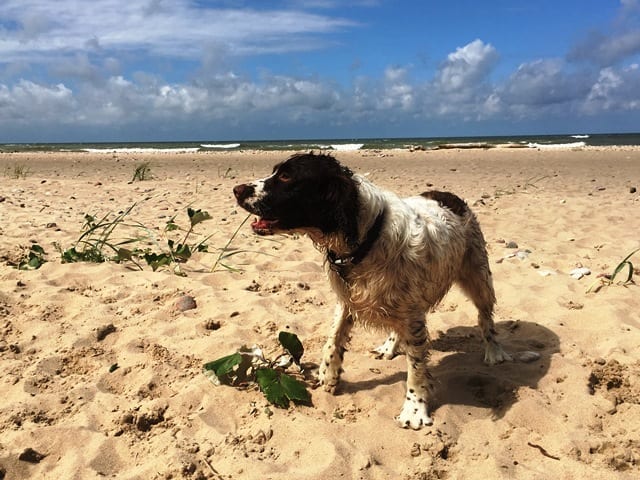
Enjoying the beach in Ventspils, Latvia
We give the dogs their main daily meal when we’ve reached our destination or overnight stop. This is because we’ll have discovered somewhere to exercise them afterwards that is more secure than a motorway services.
Other things to consider
- If you have a medium sized dog or larger, you may need them to wear muzzles in public places in certain countries – check before you travel.
- Planning to travel towards the Mediterranean during the summer? You need to be aware of processionary caterpillars near pine trees. These can be deadly.
- If you know what countries you’ll be travelling through/to, Google in advance to see what diseases are prevalent in that area so you can take advice from your vet. We always carry a tick remover with us, and check our dogs daily when away.
- Just like a human traveller, make sure your pet is insured. You never know when you might need it.
Ferry vs Tunnel
Crossing the English Channel is often the milestone that marks the beginning of the adventure. For the last 8 years we’ve only ever crossed using Eurotunnel. This is just so convenient, and if you time your crossing well you can get the best prices.
Why we don’t cross the Channel by ferry
In the past, when we had small Cavalier King Charles spaniels, we took the ferry. I was never happy about leaving the dogs in the car. Two instances jump to mind: The first was way back when car alarms were new and notoriously temperamental. We didn’t want our dogs to have to endure 90 mins of being in the vehicle with the alarm going off … so we left the car unlocked. During the crossing a bag was stolen from the foot well of the car containing my brother’s camera and camcorder. Thank goodness they didn’t let the dogs get out of the car.
The second incident was when we were made to park next to a chimney stack that was pumping out hot, dirty steam. I really didn’t feel comfortable leaving the dogs, but we had no choice. They were ok, but I was very nervous the whole time and didn’t enjoy the crossing at all. I’ve heard of dogs that did succumb to overheating while in their cars on a ferry and died. For this reason I can’t ever see myself using the ferry again, unless some changes take place. I’m thinking having kennels for your dogs to stay in during the crossing, with access at all times. Even better would be a dog-friendly lounge on board like some Scottish ferries have. I love travelling by ship so would love to use ferries more, but not until dog-friendly (and dog-owner-friendly) changes have been made.
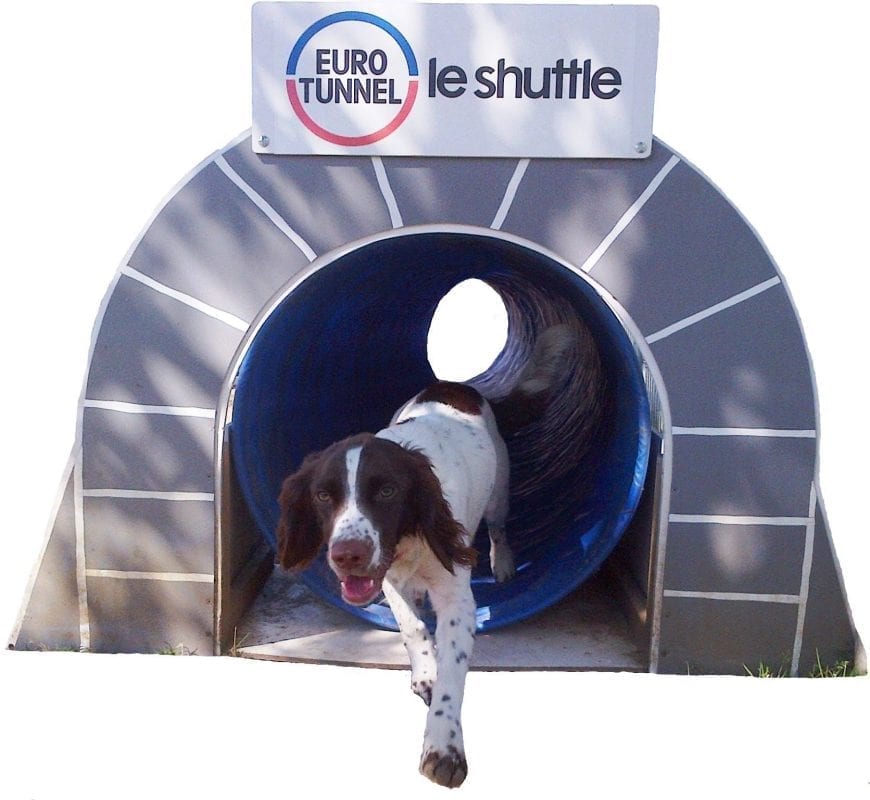
Quick leg stretch before the train crossing
Dog-friendly ferry cabins
Other ferries, that have pet-friendly cabins, are fantastic. We took a DFDS ferry one summer from Kiel in Germany to Klaipeda in Lithuania. We booked a dog friendly 4-berth cabin and the dogs had a fabulous time. It was a great trip 🙂
So if you are thinking of heading off to Europe this summer and taking your pets, now is the time to start thinking about visiting your vet to get the Pet Passport started. Research for the most suitable accommodation; and book an overseas vet, perhaps even a local dogsitter at your destination. This will allow you to explore dog-free for a few hours. It doesn’t have to be stressful. Some forward planning and knowing in advance what you need to do is all that’s required to ensure you and your pets have a great time away.
We recently took the dogs all the way to the Dordogne in France, where we spent a week exploring the countryside while staying on a dog-friendly Eurocamp site. We had a fantastic time, that we’ll post about separately. Izzy and Jack’s passports are full of vet stamps from all over Europe. They look so well travelled! I wish my passport looked as exciting 🙂